You’ve got the venue booked, the agenda locked, and your speakers confirmed.
But if your event feels like it’s flying under the radar, there’s a good chance it needs stronger event marketing support.
Even the most purpose-driven events struggle without the right visibility. In a recent study, Bizzabo found that 48% of marketers say increasing registrations is their biggest event challenge, followed closely by driving engagement across channels.
Source: Bizzabo 2024 State of In-Person Events
The good news? Most problems are fixable and often, they are early warning signs that your marketing strategy simply needs more attention, structure, or specialist support.
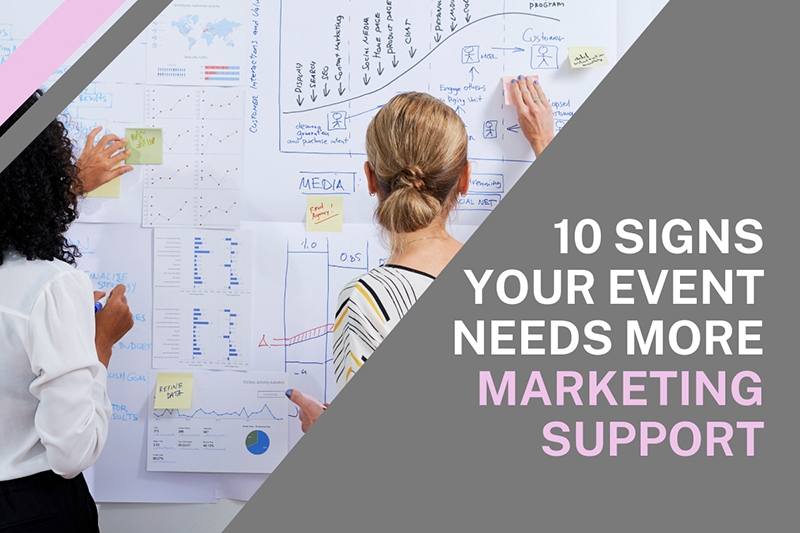
Here are 10 signs your event needs more marketing support, plus practical fixes you can use right away.
Table of Contents
2. Social media feels like a ghost town
3. Your speakers aren’t talking about the event
4. You’re doing last-minute marketing scrambles
6. Your audience targeting isn’t clear
7. Pre-event registrations are minimal
8. No media or influencer interest
9. Attendees keep asking basic questions
1. Ticket sales are flat
If registrations aren’t moving, your marketing isn’t reaching the right people or it’s not giving them a compelling enough reason to act.
Try this:
- Targeted LinkedIn or Meta ads
- Early-bird pricing or other special incentive (doesn’t have to be ticket discount. Think early pass or on-demand access)
- Clear value messaging (“Why this event? Why now? What’s in it for them”)
2. Social media feels like a ghost town
No likes, shares or comments? Low engagement on event content usually points to one (or more) of these challenges:
- Your posts aren’t reaching enough people (common with small accounts)
- The algorithm doesn’t know who to show your content to
- You’re reaching the wrong audience entirely
- Posting is inconsistent, so your event keeps “disappearing” from feeds
- The content doesn’t clearly communicate the event’s value
Strengthen what you post and how you distribute it.
Content that earns attention:
- Behind-the-scenes prep
- Speaker spotlights or quotes
- Countdown content
- Quick polls and interactive posts
- User Generated Content (UGC) from last year’s event. This includes photos, videos, testimonials or posts created by your past attendees. UGC works because it shows the real experience through the eyes of your audience, not the organiser, which builds trust and social proof.
- Short-form video
- Use event stakeholders such as registered attendees, partners and sponsors and make it easy for them to share and talk about the event (e.g. event media pack)
And when organic reach still isn’t enough… use paid support.
Paid advertising isn’t a fail, it’s a multiplier. Even a small budget behind your highest-performing posts can:
- Expand reach beyond your follower base
- Put your event in front of ideal attendees
- Improve event lead generation dramatically
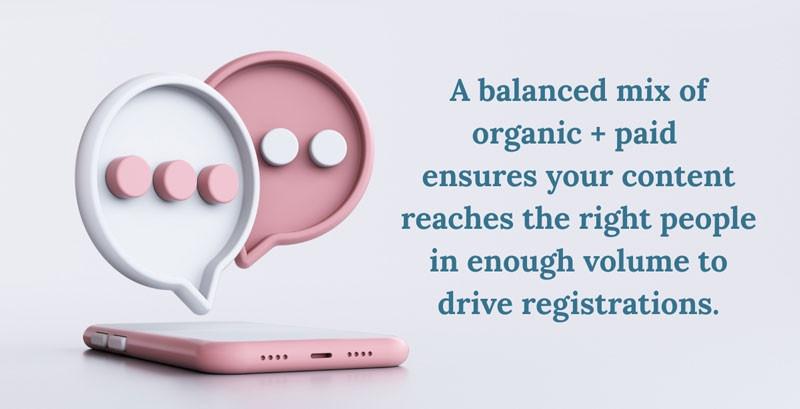
A balanced mix of organic + paid ensures your content reaches the right people in enough volume to drive registrations.
3. Your speakers aren’t talking about the event
Your speakers have authority, reach and audiences that trust them.
If they’re not promoting, you’re missing a huge multiplier effect.
Consider creating a speaker promo kit consisting of:
- Ready-made graphics
- Suggested copy
- A trackable registration link
- Short intro videos they can reuse
4. You’re doing last-minute marketing scrambles
If you’re posting in panic mode the week before the event, marketing becomes reactive instead of strategic.
And reactive marketing rarely converts.
What works best:
- Build a 12-week event marketing timeline
- Plan emails, promos and campaigns in advance
- Schedule content in batches
According to Splash, early and sustained marketing increases registrations by up to 37%.
Source: Splash Event Marketing Report
READ: The essential guide to pre-event marketing for small business events. which breaks down the essentials of event marketing and includes and downloadable Pre-event Marketing Guide.

5. Email open rates are low
If your emails are struggling, your audience either doesn’t recognise the value, or the messaging is too generic.
Give this a try:
- Test subject lines
- Segment your audience
- Personalise content
- Resend to non-openers
Small tweaks often deliver big returns.
6. Your audience targeting isn’t clear
If your messaging tries to speak to everyone, it rarely converts anyone.
A more effective approach is to define 2-3 audience personas:
- Who is this for?
- What problem are they trying to solve?
- What outcome are they hoping for?
Make the value proposition unmistakably clear.
7. Pre-event registrations are minimal
If no one is signing up early, they might not see the urgency or the value yet.
Here’s how to build momentum:
- Early-bird pricing
- Value-based messaging
- Clear takeaways
- Highlight the transformation (“You’ll leave knowing…”)
8. No media or influencer interest
If no one’s talking about your event, you’re missing powerful visibility channels.
Try this strategy:
- Pitch to industry press
- Invite niche creators
- Offer exclusive access, data, or interviews
- Create PR-ready story angles
According to Meltwater, 71% of event organisers say media partnerships significantly boost registrations.
9. Attendees keep asking basic questions
When your inbox is full of “What time does it start?” and “Where do I park?”, your communication isn’t clear enough.
A quick improvement:
- Add a clear FAQ page
- Share regular reminders
- Use automated email sequences
- Create simple visuals with need-to-know info
Good event marketing reduces cognitive load.
10. Post-event silence
If engagement dies after the event, you’re losing momentum and potential leads.
Your next move:
- Share highlights quickly
- Release session recordings
- Spotlight attendee stories
- Ask for feedback
- Create follow-up content (“5 insights from…”)
Follow-up is the heart of event ROI measurement and long-term relationship building.

Why these signs matter for small teams
Small internal teams often carry too much of the load.
The result?
- Marketing becomes inconsistent
- Engagement becomes unpredictable
- Registrations become harder to forecast
With the right strategic event marketing approach, small teams can drive outcomes that look anything but small.
If this list felt uncomfortably familiar, you’re not alone and you’re not failing. You simply need smarter support, clearer systems, and a plan that frees you up to focus on what you do best.
Conclusion
Strong Event Marketing Support isn’t optional, it’s what drives results. When your marketing support is working, you’re not just filling seats, you are getting the right people in the room for the right reasons.
If you recognised any of these 10 signs, now is the moment to pause, recalibrate and build the support your event deserves.
👉 Download the Event Marketing Health Checklist
Spot issues early. Fix them fast. Make your next event your strongest yet.
Table of Contents
2. Social media feels like a ghost town
3. Your speakers aren’t talking about the event
4. You’re doing last-minute marketing scrambles
6. Your audience targeting isn’t clear
7. Pre-event registrations are minimal
8. No media or influencer interest
9. Attendees keep asking basic questions
Love what you’re reading? Let’s connect on LinkedIn
Ready to plan your next impactful event? Let’s talk about how we can help you increase registrations, generate leads and build events that truly matter.

The Psychology of a Great Event: What Makes People Remember?
Let’s face it – most events blur together. You attend, you smile, you sip the coffee, and then…...

Unlock Event Success: The must-have elements for high-converting sales page
If your event is packed with purpose, passion, and potential, but your ticket sales aren’t...
Launch without launching – the soft launch approach
The prospect of launching a new service, programme, or course can be overwhelming for many...